
Multiplication Math Facts, by Dr. Cotter
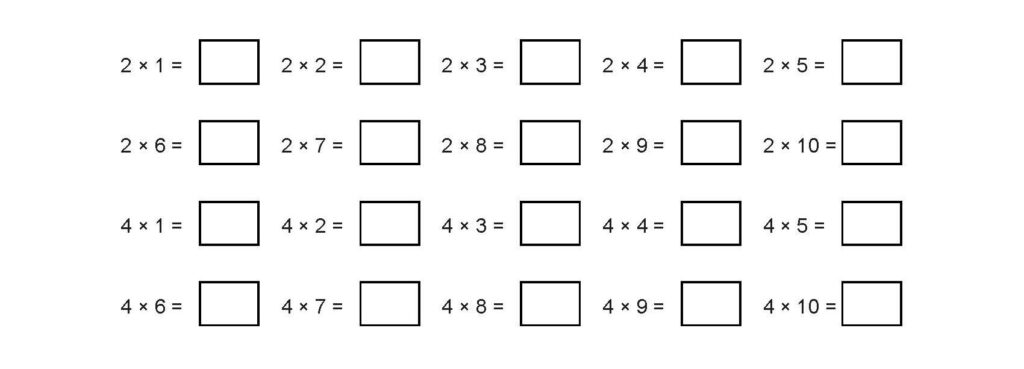
For many children, multiplication causes a mathematical collapse. What is the reason? They are required to memorize 100 or more multiplication math facts. As instructors, we must first teach our students what multiplication is before expecting them to memorize the facts. Then, we need to use good research-based approaches that will reduce the burden of memorizing numerous multiplication math facts. What is Multiplication? Many times, we teach multiplication as repeated addition. However, this limited view does not work when multiplying fractions and decimals. One essential application of multiplication is finding area. So, let’s use the array model (arranging items in rows and columns) to help students understand multiplication. Start by having the student build three rows of six objects, which is 6 multiplied by 3, or using Montessori terms, “Six taken three times.” The student can clearly see that “six taken three times” gives a product of 18 simply by looking at the array. Different Interpretations of Math Facts Multiplication problems can be viewed differently. When looking at 6 × 3, some can think of it as 6 groups of 3. However, a better interpretation is to think of it as 6 repeated 3 times. Why? Because it is more consistent with the rest of arithmetic. When we add 6 + 3, we transform 6 by adding 3 more to it. As we subtract 6 – 3, we transform the 6 by decreasing it by 3. When we divide 6 by 3, we transform the 6 by dividing 6 into 3 groups or dividing 6 into groups of 3. Therefore, for consistency, we should consider 6 × 3 as starting with 6 and transform it by duplicating it 3 times. This interpretation can also be used in the Cartesian coordinate system. We can represent 6 × 3 in an array of 3 rows of 6, similar to plotting the point (6, 3) on a grid, where 6 refers to the horizontal number, and 3 refers to the vertical number. Math Fact Instruction Missteps Rote Memorization Students are often encouraged to learn multiplication math facts by rote, which many students find overwhelming. Why? They have already learned that 6 and 3 is 9. But suddenly, now it is 18. Instead of just learning multiplication math facts from 1 × 1 to 10 × 10, students are further burdened by extending the number of facts from 1 × 1 to 12 × 12, which adds another 44% more math facts they need to memorize. This heavy load can be reduced by teaching students strategies to quickly calculate 11s and 12s. For example, they can solve 12 × 3 in two steps: (10 × 3) + (2 × 3) which is 30 + 6 = 36 Songs and Rhymes Many teachers use songs or rhymes to help their students learn the facts, another misplaced strategy. One disadvantage to this strategy is that the child must sing through the entire song to get the answer they need. A second disadvantage is that the brain must transfer the song or rhyme information from the language part of the brain to the math part of the brain, increasing processing time. Pictures and Images Yet another instructional misstep is teaching facts through pictures, one picture for each multiplication math fact. For example, to help the student learn and retain 4 × 4, one image shows a 4-wheel-drive truck. Then, the child is told that the driver must be 16 to drive. When I saw this, the legal driving age in North Dakota was 14. Does that mean that in North Dakota, 4 × 4 is 14? On a serious note, unfortunately, pictures can delay math fact fluency as the student mentally retrieves unrelated images to mathematical concepts. Skip Counting A commonly used instructional strategy is to teach children to skip count to learn the facts. However, when children learn to skip count, they often end up just counting on their fingers to get to an answer. I once saw this strategy used in a school in England. The result was that the students became quick at counting but did not master the facts. It just became a procedure for them to memorize. A Common Misconception about Math Facts One common misconception about multiplication is the belief that a product is always greater than the factors. However, consider 7 × 1. In this case, the product is equal to one of the factors, not greater than. Another example of this is when multiplying by zero. For example, 257 × 0 gives the product of 0, which is less than 257. Finally, the product is always less than either fraction when multiplying proper fractions. Consider ½ × ½ is ¼, which is less than ½. Superior Instructional Strategies Commutative Property We can reduce the burden of memorization by helping our students understand the commutative property. Isn’t it amazing that 6 × 4 is the same as 4 × 6? By introducing this property, students only need to learn 55 math facts rather than 100 (when using a 10 by 10 table). Of course, for most students, learning the 1s multiplication math facts is easy. For example, the student can understand that 1 × 8 is 1 repeated 8 times, which is 8. Then, when using the commutative property, 8 × 1 is also 8 or can be understood as 8 taken 1 time. The multiples of 2s are easily known from the addition math facts. For example, 5 × 2 is the same as 5 taken 2 times or 5 + 5. Simple enough. Finally, the multiples of 10 are also easy, as they are learned as they work on place value ideas. That leaves only 28 more multiplication math facts to learn! Visualization Strategy Students can visualize strategies to help them ‘see’ the math facts when using the Cotter Abacus. Let’s see how this works by considering 6 × 4, as shown below, using O’s and X’s. As you look at O’s on this array, you can see two sets of 10.
Place Value, by Dr. Joan A. Cotter
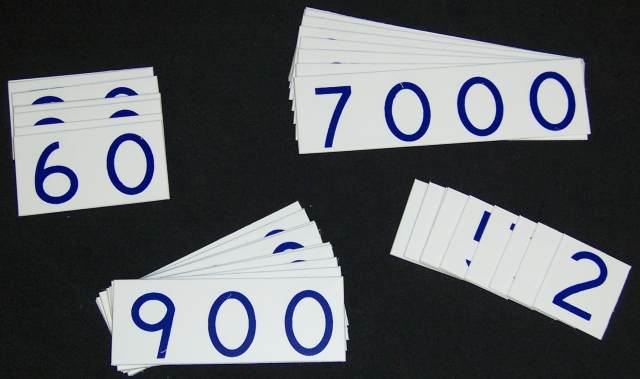
Place value is the foundation of arithmetic. Unfortunately, many children and even some adults find it a difficult concept to understand. In Western cultures, children are usually taught to add two numbers together by counting. However, this counting strategy does not acknowledge place value. When children think of arithmetic in terms of tens and ones, counting becomes a burden. When numbers are grouped into tens and tens of tens, and so forth, adding large numbers becomes similar to adding single-digit numbers. In the fifteenth century, the first printed arithmetic text, Treviso Arithmetic of 1478, considered place value so significant that it was listed as one of the five fundamental operations: numeration (place value), addition, subtraction, multiplication, and division. It wasn’t until 1911 that place value was included in the dictionary. Before that, the concept was referred to as numeration. Transparent Number Naming As previously stated, people in Western cultures struggle with place value. However, Asian cultures do not experience the same struggle. Why is that? Because most Asian languages use transparency in their number naming. For example, the number eleven is spoken as ten-1, twelve is ten-2, and fifteen is ten-five. In English, the teen numbers are reversed. The word for the ones place is named first, and the ten (or teen) is named second. For example, four is in the ones place in fourteen, yet it is said first. In addition, the tens place is spoken as teen, effectively masking place value. Another example is twenty-one. The Asian languages say this number as 2-ten 1, but in English, the ten is spoken as -ty, again veiling place value. When children learn the transparent words for numbers, they can more easily use tens-based strategies when calculating quantities. For example, when adding 9 + 5, they know they can take 1 away from the 5, making the 9 a 10. Now, they have modified the problem to be 10 + 4, which is easier to solve. Unfortunately, many English-speaking children in the first grade do not readily know what 10 + 4 is. What can we do about this? We can temporarily use transparent number naming for quantities 11 to 99 when we teach our students. In my experience and research, I have seen that children using transparent number naming gain the same understanding as Asian students. When using transparent number names, the sum of 10 and 4 is simply ten-4. Easy as that! Place Value Cards Students should also use place value cards while saying transparent number names and counting by tens. We can help the student learn place value through syllables. When saying the number 2-ten, we can show the place value card of 20 and point to the 2 when saying two and point to the 0 when saying ten. As the student continues to count by 10 using place value cards, we will show them the 100 place value card. This number can be called 10-ten, with the first two digits showing a ten and the last zero showing a ten. This number has another name, one hundred. We can point to the 1 while saying one, then point to the first zero as we say hun, and finally, point to the last zero while we say dred. Students can see and hear place value when syllables are added to this activity. As students grow in their understanding of numbers, we can begin to combine numbers with different place values and stack the corresponding place value cards. Start with the longest place value card on the bottom and align the edges of the other cards on the right side. For example, for the number 159, the 100 card would be on the bottom, and the 50 card would be next and aligned on the right edge. Finally, the 9 card would be on top, again lined up on the right edge, showing 159. Place value cards are especially beneficial for numbers such as 206. The student only hears the hundreds place and the ones place. However, when they stack the cards, they see that the tens place has a 0, notating that there are no tens. While it is not heard, it still needs to be seen. Another benefit of place value cards is that they encourage the student to read numbers from left to right. The student first says the name of the number, observes how many digits follow it, and then says the correct place value word. Older strategies had students start on the right, name the column heading, and determine the place value of the digit furthest on the left. However, teaching our students to read numbers from left to right is most effective because we read words from left to right. Transition to Traditional Number Names Once your student understands place value well, you can easily transition them to the traditional number names. You can start by telling them that ten can also be said as ty. So, 4-ten becomes forty, 6-ten becomes sixty, and 9-ten becomes ninety. The numbers 13, 15, 30, and 50 use the ordinal prefixes of thir and fif. So, help your students learn these by starting the instruction by having them say first, second, third, fourth, and fifth. Encourage them to see the relationship between the ordinal numbers and the traditional number names. Because the w in two-ten is silent, when you introduce the word twenty, emphasize the w in the same way as it is pronounced in twelve, twin, and twice. When you teach the teen numbers 13 through 19, tell your students that ten is also pronounced teen. The teen numbers are also said in reverse order. You can introduce this to your students by having them play a game. Give them a compound word and have them say the reverse. For example, you say fireplace and the student says place fire. You say, box-mail and the student replies, mailbox. Then they do the same with the teen numbers: ten-four becomes teen-four, and the reverse is fourteen. History of Eleven and Twelve Where do the words eleven and twelve come from? They do not fit the same pattern as
Addition and Subtraction Facts, by Dr. Joan A. Cotter
Teachers and parents often want their children to know their addition and subtraction facts so well that they can regurgitate them instantly. In an attempt to accomplish this rote learning feat, children are subjected to flashcards and timed tests. However, research shows that a different part of the brain is involved in rote memory compared to mathematical thinking. In fact, the only person who likes flashcards is the person who doesn’t need them. For those needing the practice, a missed flashcard reminds them of what they don’t know. An unintended unfortunate outcome of flash cards and timed tests is math anxiety. Rote memorization has its place in learning, but mastering addition and subtraction facts is not one of them. So, how should we help students learn their math facts? By teaching them strategies. Strategies to Learn Addition Math Facts Addition is more than just memorizing a numeric symbol plus another numeric symbol equals a different numeric symbol. One way to think of addition is finding a whole amount when two or more parts are known and understood. Students who understand place value find it easier to learn the sum of two numbers. Basic addition math facts, 1 + 1 through 9 + 9, are best learned through visualizable strategies and frequent practice and use. Group by Fives Before learning the addition strategies below, the student must first be able to recognize quantities, specifically the ability to group in fives, like the fingers on their hands. When introducing an addition strategy, the student must be encouraged to use concrete objects grouped in fives. Over time, the student can mentally visualize eliminating the need for concrete objects. For example, if you were asked to add 4 + 3, imagine a group of 4 objects and then imagine another group of 3 objects. Then imagine taking one object from the group of three objects and giving it to the group of 4 objects. So, now you have one group of 5 and another group of 2, which you know as 7. Let’s look at another example. If asked to add 7 and 3, you can first think of 7 as 5 and 2. The 2 combined with the 3 makes another 5. And you know that 5 + 5 is 10. In written form, this equation looks like this: 7 + 3 = (5 + 2) + 3 = 5 + (2 + 3) = 5 + 5 = 10 While this equation appears complicated, this process is quick and efficient when working with objects. Students do not need to write out the process in equation form. Two Fives Strategy A strategy to use for slightly larger sums is the Two Fives Strategy. Here’s how this strategy works with problems such as 7 + 6. First, consider 7 as a group of 5 and 2 and 6 as a group of 5 and 1. The Two Fives Strategy (hence the strategy name) is 10 and 2 plus 1 is 3. This gives us a sum of 10 + 3 or 13. Children can use their hands while using this strategy. When they think of 7, they show two fingers on their left hand. When they think of 6, they show one finger on their right hand. They combine the two fives and add their raised fingers, giving the answer as 10 + 3 or 13. Make a Ten Strategy Another great strategy to teach is Make a Ten Strategy. With this strategy, students take a sufficient amount from the smaller number to make the number into a 10. Let’s look at 8 + 8 as an example. We can take 2 from one of the 8s and give it to the other 8 to make 10. This gives us 10 + 6, which is 16. Doubles Strategy Should we teach the Doubles Strategy? One textbook author suggests that students find the doubles easier to learn. However, I believe that children learn the doubles math facts faster simply because teachers and parents have the students practice them more frequently. It is important to remember that a child is considered to know a math fact if they can answer it in 2 to 3 seconds, not necessarily instantaneous. The teacher and parent should give the student enough time to process the math fact and the appropriate strategy to solve it. Strategies to Learn Subtraction Math Facts Subtraction can also be thought of as modified addition: finding one of the parts when given the whole and another part. For example, when looking at this math fact, 3 + ___ = 7, we can see that 7 is the whole and 3 is a part. What is the other part? Four. We can also write this equation as 7 – 3 = ___. When stating this equation, avoid saying, 7 take away 3. This is incorrect grammar. In addition, students can often learn subtraction math facts when they think of it as addition. Instead, when stating subtraction math facts, use the term minus, such as 7 minus 3. Three subtraction strategies will help students master math facts: Going Up Strategy, Taking Part from Ten Strategy, and Taking All from Ten Strategy. To prepare students for these strategies, make sure they understand that 15 is 10 and 5. Let’s explore these strategies by working through the math fact of 15 – 8. Going Up Strategy When using this strategy for 15 – 8, we first start with the 8. Then consider that 2 can be added to 8 to get to 10, and 5 more is needed to get to 15. So, 2 + 5 is 7; therefore, 15 – 8 is 7. Taking Part from Ten Strategy For the math fact 15 – 8, we will start by partitioning 8 into easy to subtract quantities, such as 5 and 3. So, 15 – 5 is 10. Then subtract the remaining 3 from the 10, leaving 7 as the difference. Taking All from Ten Strategy Again, we will use the same math fact of