
Fractions, by Dr. Cotter
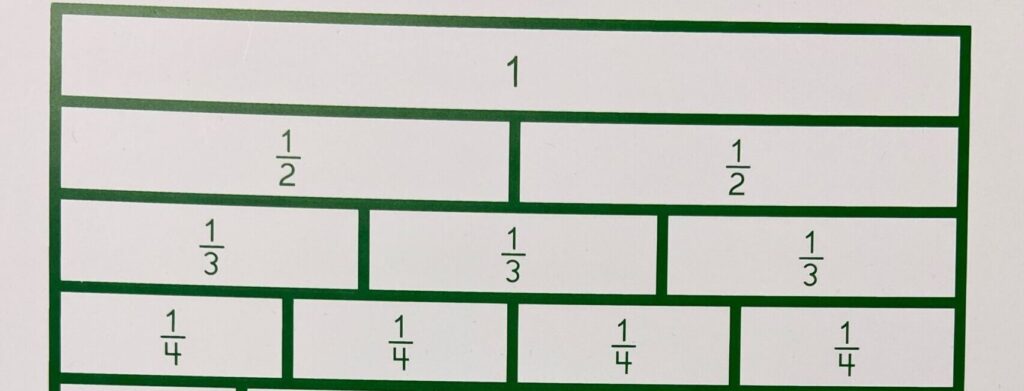
Many people have the idea that fractions are incomprehensive and unpredictable. In fact, cartoons often express the fear of them as a source of amusement. However, when they are understood, they are amazing. They are also necessary for everyday life. For example, telling time, counting money, and cooking utilize fractions. History of Fractions Historically, fractions were only considered as part of a whole and could never be greater than one. The term fraction comes from the Latin word frangere, which means “to break.” In the 1600s, the concept of fractions expanded. Mathematicians began using fractions as dividing two whole numbers. For example, one-third became thought of as 1 divided by 3. This new idea expanded fractions to include what we now call improper fractions. For example, 3/3 and 4/3 are now legitimate fractions because 3 could be divided by 3, and 4 could be divided by 3, resulting in a number equal to or greater than 1. Not everyone welcomed this new view. So, those fractions that followed the traditional understanding of being less than a whole were named proper fractions. The new fractions, those that were not less than a whole, were called improper fractions. Unfortunately, we still use the traditional idea of fractions as being part of a whole or as a part of a larger amount. In fact, the dictionary defines fractions as ‘a tiny part.’ If you look up fractions in a Thesaurus, you will see synonyms such as “fragment” or “snippet.” However, this is a limited view and can prevent or reduce the student’s understanding of them. Fractions as Division If fractions are now considered division, why do we still use the terms numerator and denominator instead of dividend and divisor? These terms were used in the 1540s, where numerator referred to a counting process. The denominator referred to the parts being counted. This process created useless memory work. When I teach fractions, I delay introducing these terms for as long as possible. When teaching math to children, the main goal is to help the child see the relationship between concepts. Therefore, we need to teach fractions as division as early as possible because they need to understand the link between fractions and division. Circular Fraction Model A common model used today, and one of the earliest models used for teaching fractions, is the circle. Many teachers use the “pizza model” to engage their students and help understanding. However, this model has serious drawbacks. Many would agree that it is easy to see 1/2, 1/3, and even 1/4 of a circle. But, it is significantly more challenging to see or visualize 1/7, 1/8, or 1/9. There are other drawbacks when using the circular fraction model. How do you compare fractions? For example, how do you help the student 4/5 with 5/6 when using the circular fraction model? Can they cut out the pie pieces to compare the size of the shapes? What do you do with fractions that are greater than 1? Linear Fraction Model The Linear Fraction Model or fraction strips is a more powerful and versatile model to use when teaching fractions. The linear fraction model includes a series of ten rectangles that are 8 to 10 inches long each. The top strip has ‘1’ written in the center of it. The second strip is broken in half, with 1/2 written in the center of each segment. This pattern continues for the remaining strips to the tenths. These strips are placed in order, one right under the other, to form a fraction chart. There are several variations of this model. Some fraction charts have different colors for each fraction family. While this may seem helpful for instructions, the colors actually create a distraction, and the size of the pieces is not as quickly seen. For this model to be effective, all the strips should be the same color. Another variation of the fraction chart is removing the lesser-used fractions and adding additional ones. For example, some of these charts remove the 7ths and the 9ths and then add the 12ths. Not only are we telling our students that if we do not like the numbers, we don’t use them, but we also keep them from seeing interesting patterns within the fraction chart. When looking at a complete fraction chart, the student can see interesting arc patterns (hyperbolas). When you introduce the fraction chart to your students, have them begin by assembling the strips like a puzzle while having the full fraction chart available as a reference. Even young children enjoy building the fraction puzzle again and again. Your students can do another fun activity by creating the fraction stairs. By the way, they can see half of a hyperbola when they do so! A Story About Mike Several years back, I tutored a third-grade student named Mike. He was moving out of the area and needed help in math. To help Mike learn the foundation of fractions, I started by having him assemble the fraction chart like a puzzle. When he completed that task, I asked him, “Which is more 4 or 5?” He answered, ‘Five.” Then, I asked him, “But which is more, 1/4 or 1/5?” After viewing the chart, he stated, “1/4.” Once I saw that he quickly responded, I continued to ask him similar questions, such as “Which is more 2 or 3?” and “Which is more “1/2 or 1/3?” Then I expanded on the topic by asking him different questions, such as “How many thirds is needed to make a whole?” After viewing the chart, he said, “3.” Then, I asked how many fourths, fifths, etc. And he was able to answer the questions. After I explained to Mike how 3/4 was three 1/4s, Mike showed me where 3/4s was on the fraction chart. We spent some more time working through similar fraction associations. At the end of a 45-minute tutoring session, I told Mike that he had done a great job but that he still had not yet learned everything there was to know
What Makes RightStart™ Math Different?

When looking for a math curriculum, schools and teachers want: A comprehensive mathematics program that will increase student test scores One that is easy to teach One that gives students the foundation they need for everyday living in our technological world One that gives students a solid understanding and love for math This research-based, comprehensive RightStart™ Mathematics program, is used worldwide. It provides students with the foundation they need by helping them understand abstract mathematical concepts. What Makes RightStart™ Math Different? RightStart™ Math is a unique program that Incorporates visualization of quantities De-emphasizes counting Provides strategies for learning the facts Visualization and Grouping The primary learning tool used in RightStart™ Math is the Cotter Abacus. This specially designed and effective learning tool is hands-on and develops a visual model of mathematical ideas. It engages students in the learning experience while providing them with an interactive instructional model that will deepen their understanding of abstract mathematical concepts. To appreciate visualization, try to imagine eight apples in a line without grouping them–virtually impossible. Next, imagine five of those apples as red and three as green. Now, you can see them. Students learn to use these mental models for doing arithmetic. Counting is an inaccurate and inefficient model that ignores place value. However, when students learn to group in quantities of fives and tens, they can quickly visualize the solution, enabling them to solve problems quicker and more accurately. Look at the figures below. Without counting or grouping, can you tell how many blocks are in the left figure? How many are in the right figure? Comprehension In RightStart™ Math, understanding is emphasized. Jo Boaler, a mathematics professor at Stanford University, said, I have never committed math facts to memory, although I can quickly produce any math fact. She goes on to say, “My lack of memorization has never held me back at any time or place in my life, even though I am a mathematics professor, because I have number sense, which is much more important for students to learn and includes the learning of math facts along with a deep understanding of numbers and the ways they relate to each other. When students understand number sense, they need less time reviewing the math facts. Conversely, rote memorizing, is high maintenance, requiring constant review. Students who learn math facts through memorization usually can’t apply them to new ideas. A better way to help students learn and retain math facts and concepts is to help them understand them. Place Value RightStart™ Math introduces place value early. The Place Value Cards are a tactile and visual tool to help students learn how to construct numbers and read them from left to right. They can see the pattern that ten 1s is 10, ten 10s is 100, and ten 100s is 1000 by working with 4-digit numbers, even in first grade. Traditional math programs stop at 99, preventing the students from seeing this pattern. “Why the Cotter Abacus?” We know that children learn best when they work with physical models to explore math’s inherent patterns. The Cotter Abacus has 100 beads grouped in fives by color and grouped in tens by rows. When students use the beads to add two or more quantities together, the sum is obvious. No counting is required. The Cotter Abacus also provides visual pictures to help the children master the facts. Even though students enjoy using it, it doesn’t become a crutch because they develop a mental image of the patterns and strategies taught to them through the abacus, removing the need for it. One day, a five-year-old boy named Stan was asked, “How much is 11 + 6?” He answered 17. When asked how he knew the answer, he said,“I’ve got the abacus in my mind.” Discover for Yourself the Difference RightStart™ Math Makes For more information about RightStart Math and how it will help your students grow in their understanding of mathematical concepts, check out the curriculum and intervention pages. You can also contact us for more information and to find out how you can get these materials in your school. RightStart Math’s Mission: To help everyone understand, apply, and enjoy mathematics.
Math Manipulatives, by Dr. Joan A. Cotter
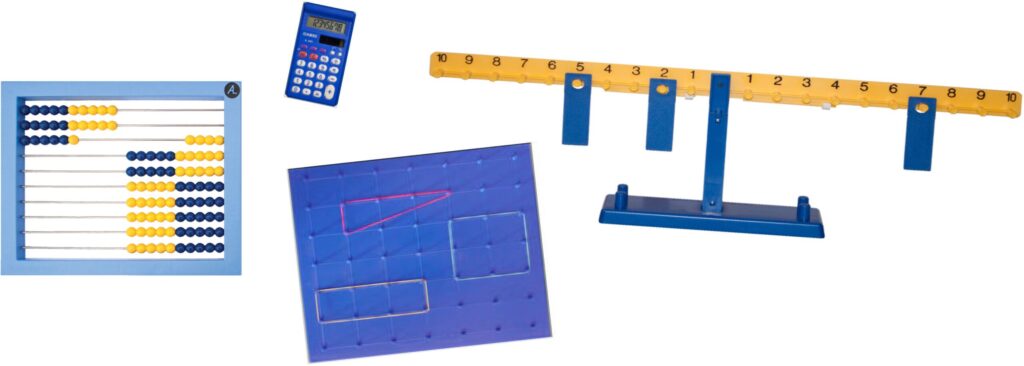
Should teachers use manipulatives when teaching math? What is the purpose of manipulatives? Are some manipulatives better than others? Every mathematics teacher should ask these questions as consider how to effectively teach their students. Let’s start by considering: What is a manipulative? A manipulative is a tangible object a child can physically handle to learn math. Some curricula do not encourage concrete manipulatives at all. Other curricula only use physical manipulatives as a last resort or when the child has learning difficulties. However, other programs, like RightStart Math, use concrete manipulatives as a tool for understanding. What makes an excellent manipulative? An excellent physical manipulative is one the child can imagine, internalize, visualize, and use in their mind. RightStart Math uses specific manipulatives to ensure students can visualize and internalize the math concepts they are being taught. A few of the excellent manipulatives used throughout the RightStart Math curriculum are the Cotter Abacus, overlapping place value cards, fraction charts, base-10 picture cards, and centimeter cubes. How long should my students use manipulatives? According to research, it takes a child one year of regularly using the manipulative to gain the full benefit of it. Many teachers use a manipulative to demonstrate a concept but do not allow enough time for students to explore, discover, and apply mathematical ideas. Remember, a good manipulative can be internalized. It takes time for a student to visualize the concepts a manipulative conveys. Aren’t all math materials considered manipulatives? Many believe that math materials such as rulers, geoboards, calculators, goniometers, clocks, and coins are manipulatives. But really, they are math tools and applications of math, not manipulatives. How important are manipulatives, anyway? Researchers have found there are two vital outcomes when children use manipulatives: They learn and understand mathematics better They have a positive attitude toward math These two outcomes occur when manipulatives are used while teaching a mathematical idea, not as a reward for completing a project or assignment. When concrete materials and games are considered rewards for good behavior, the student views the manipulative as nonessential and is less likely to take it seriously. However, simply using a manipulative does not guarantee the student understands a math concept. Ben A. Sueltz stated, Devices themselves will teach very little arithmetic. It is the guidance of a good teacher that determines their usefulness in discovery and learning. “Counting devices and their uses.” Arithmetic Teacher 1, no. 1 (1954): 25-30 Can I use everyday objects as manipulatives? Some professionals suggest that objects commonly found within the home are good alternatives to math manipulatives because they make math seem more relevant. While this might be true for some math concepts, everyday items do not necessarily make a good math manipulative. In fact, the more interesting the object is in its own right, the harder it is for the child to see the intended mathematical idea it is trying to demonstrate. For example, students who use raisins and candies to view and manipulate quantities can find the treats too tempting, and their attention is pulled away from the math concept. Summary Teachers and schools can choose from a wide array of manipulatives to use in their math classrooms. Each year, new manipulatives are being developed. However, teachers should be selective and intentional to only incorporate good manipulatives in their instruction. The manipulatives they choose should help students understand abstract concepts, make mathematical connections, and enjoy learning math.
Symmetry, by Dr. Joan A. Cotter

The Hungarian journal, Symmetry: Culture and Science, published Dr. Cotter’s article called “Symmetry for Children Using Drawing Board Tools and Tangrams.” In this article, Dr. Cotter explains how children as young as 5 years old can create equilateral triangles, hexagons, squares, and other figures using a scaled-down version of traditional drafting tools, such as the T-square, 30-60 triangle, and the 45 triangle. Older students are able to draw lines and create figures around a line of symmetry, both vertically and horizontally, using these drawing tools along with tangram pieces. As students work through the activities discussed in the article, they learn to analyze what needs to be drawn and how to make a plan to achieve the desired results. Throughout this piece, Dr. Cotter explains how to use drawing tools to divide equilateral triangles into halves, thirds, fourths, ninths, and twelfths. She shows examples of how to draw equilateral triangle symmetry, hexagon symmetry, square symmetry, and tangram symmetry that involve rotation and variations. You will also see colorful examples of how to draw inscribed and overlapping stars, which are activities students thoroughly enjoy. Learn about the educational benefits students gain when teaching more than just basic arithmetic. One benefit of drawing activities is that they combine artistry and mathematics. As students work through these engaging projects, they enjoy their creations, develop an appreciation for geometry, and discover the beauty of mathematics. To read the article in full and get ideas of how you can bring more geometry into your classroom, click here. Contact us for more information about how RightStart Math includes geometry in the curriculum, even in the elementary grades.
Multiplication Math Facts, by Dr. Cotter
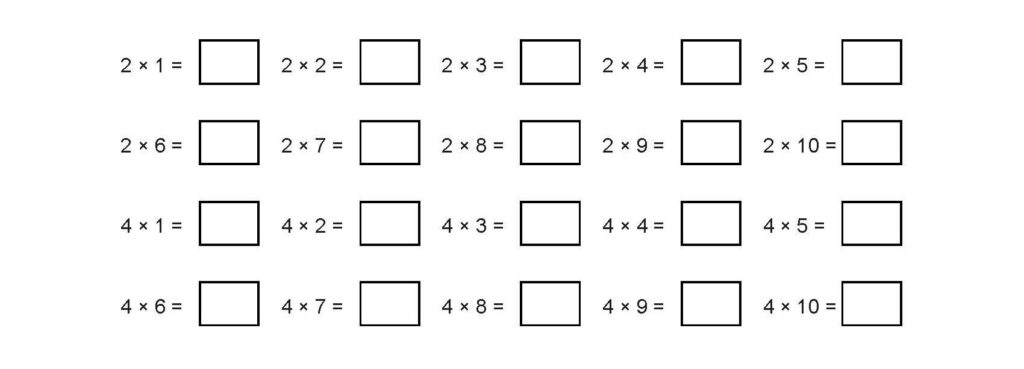
For many children, multiplication causes a mathematical collapse. What is the reason? They are required to memorize 100 or more multiplication math facts. As instructors, we must first teach our students what multiplication is before expecting them to memorize the facts. Then, we need to use good research-based approaches that will reduce the burden of memorizing numerous multiplication math facts. What is Multiplication? Many times, we teach multiplication as repeated addition. However, this limited view does not work when multiplying fractions and decimals. One essential application of multiplication is finding area. So, let’s use the array model (arranging items in rows and columns) to help students understand multiplication. Start by having the student build three rows of six objects, which is 6 multiplied by 3, or using Montessori terms, “Six taken three times.” The student can clearly see that “six taken three times” gives a product of 18 simply by looking at the array. Different Interpretations of Math Facts Multiplication problems can be viewed differently. When looking at 6 × 3, some can think of it as 6 groups of 3. However, a better interpretation is to think of it as 6 repeated 3 times. Why? Because it is more consistent with the rest of arithmetic. When we add 6 + 3, we transform 6 by adding 3 more to it. As we subtract 6 – 3, we transform the 6 by decreasing it by 3. When we divide 6 by 3, we transform the 6 by dividing 6 into 3 groups or dividing 6 into groups of 3. Therefore, for consistency, we should consider 6 × 3 as starting with 6 and transform it by duplicating it 3 times. This interpretation can also be used in the Cartesian coordinate system. We can represent 6 × 3 in an array of 3 rows of 6, similar to plotting the point (6, 3) on a grid, where 6 refers to the horizontal number, and 3 refers to the vertical number. Math Fact Instruction Missteps Rote Memorization Students are often encouraged to learn multiplication math facts by rote, which many students find overwhelming. Why? They have already learned that 6 and 3 is 9. But suddenly, now it is 18. Instead of just learning multiplication math facts from 1 × 1 to 10 × 10, students are further burdened by extending the number of facts from 1 × 1 to 12 × 12, which adds another 44% more math facts they need to memorize. This heavy load can be reduced by teaching students strategies to quickly calculate 11s and 12s. For example, they can solve 12 × 3 in two steps: (10 × 3) + (2 × 3) which is 30 + 6 = 36 Songs and Rhymes Many teachers use songs or rhymes to help their students learn the facts, another misplaced strategy. One disadvantage to this strategy is that the child must sing through the entire song to get the answer they need. A second disadvantage is that the brain must transfer the song or rhyme information from the language part of the brain to the math part of the brain, increasing processing time. Pictures and Images Yet another instructional misstep is teaching facts through pictures, one picture for each multiplication math fact. For example, to help the student learn and retain 4 × 4, one image shows a 4-wheel-drive truck. Then, the child is told that the driver must be 16 to drive. When I saw this, the legal driving age in North Dakota was 14. Does that mean that in North Dakota, 4 × 4 is 14? On a serious note, unfortunately, pictures can delay math fact fluency as the student mentally retrieves unrelated images to mathematical concepts. Skip Counting A commonly used instructional strategy is to teach children to skip count to learn the facts. However, when children learn to skip count, they often end up just counting on their fingers to get to an answer. I once saw this strategy used in a school in England. The result was that the students became quick at counting but did not master the facts. It just became a procedure for them to memorize. A Common Misconception about Math Facts One common misconception about multiplication is the belief that a product is always greater than the factors. However, consider 7 × 1. In this case, the product is equal to one of the factors, not greater than. Another example of this is when multiplying by zero. For example, 257 × 0 gives the product of 0, which is less than 257. Finally, the product is always less than either fraction when multiplying proper fractions. Consider ½ × ½ is ¼, which is less than ½. Superior Instructional Strategies Commutative Property We can reduce the burden of memorization by helping our students understand the commutative property. Isn’t it amazing that 6 × 4 is the same as 4 × 6? By introducing this property, students only need to learn 55 math facts rather than 100 (when using a 10 by 10 table). Of course, for most students, learning the 1s multiplication math facts is easy. For example, the student can understand that 1 × 8 is 1 repeated 8 times, which is 8. Then, when using the commutative property, 8 × 1 is also 8 or can be understood as 8 taken 1 time. The multiples of 2s are easily known from the addition math facts. For example, 5 × 2 is the same as 5 taken 2 times or 5 + 5. Simple enough. Finally, the multiples of 10 are also easy, as they are learned as they work on place value ideas. That leaves only 28 more multiplication math facts to learn! Visualization Strategy Students can visualize strategies to help them ‘see’ the math facts when using the Cotter Abacus. Let’s see how this works by considering 6 × 4, as shown below, using O’s and X’s. As you look at O’s on this array, you can see two sets of 10.
Place Value, by Dr. Joan A. Cotter
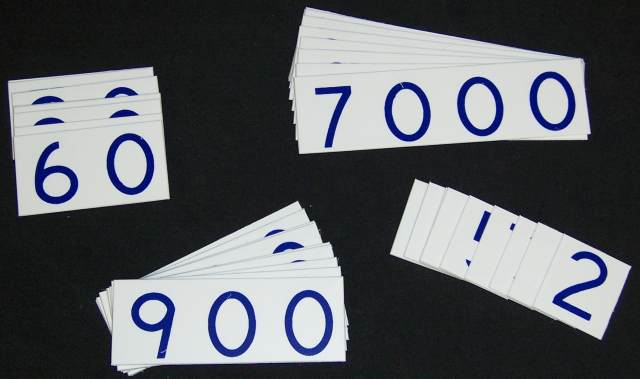
Place value is the foundation of arithmetic. Unfortunately, many children and even some adults find it a difficult concept to understand. In Western cultures, children are usually taught to add two numbers together by counting. However, this counting strategy does not acknowledge place value. When children think of arithmetic in terms of tens and ones, counting becomes a burden. When numbers are grouped into tens and tens of tens, and so forth, adding large numbers becomes similar to adding single-digit numbers. In the fifteenth century, the first printed arithmetic text, Treviso Arithmetic of 1478, considered place value so significant that it was listed as one of the five fundamental operations: numeration (place value), addition, subtraction, multiplication, and division. It wasn’t until 1911 that place value was included in the dictionary. Before that, the concept was referred to as numeration. Transparent Number Naming As previously stated, people in Western cultures struggle with place value. However, Asian cultures do not experience the same struggle. Why is that? Because most Asian languages use transparency in their number naming. For example, the number eleven is spoken as ten-1, twelve is ten-2, and fifteen is ten-five. In English, the teen numbers are reversed. The word for the ones place is named first, and the ten (or teen) is named second. For example, four is in the ones place in fourteen, yet it is said first. In addition, the tens place is spoken as teen, effectively masking place value. Another example is twenty-one. The Asian languages say this number as 2-ten 1, but in English, the ten is spoken as -ty, again veiling place value. When children learn the transparent words for numbers, they can more easily use tens-based strategies when calculating quantities. For example, when adding 9 + 5, they know they can take 1 away from the 5, making the 9 a 10. Now, they have modified the problem to be 10 + 4, which is easier to solve. Unfortunately, many English-speaking children in the first grade do not readily know what 10 + 4 is. What can we do about this? We can temporarily use transparent number naming for quantities 11 to 99 when we teach our students. In my experience and research, I have seen that children using transparent number naming gain the same understanding as Asian students. When using transparent number names, the sum of 10 and 4 is simply ten-4. Easy as that! Place Value Cards Students should also use place value cards while saying transparent number names and counting by tens. We can help the student learn place value through syllables. When saying the number 2-ten, we can show the place value card of 20 and point to the 2 when saying two and point to the 0 when saying ten. As the student continues to count by 10 using place value cards, we will show them the 100 place value card. This number can be called 10-ten, with the first two digits showing a ten and the last zero showing a ten. This number has another name, one hundred. We can point to the 1 while saying one, then point to the first zero as we say hun, and finally, point to the last zero while we say dred. Students can see and hear place value when syllables are added to this activity. As students grow in their understanding of numbers, we can begin to combine numbers with different place values and stack the corresponding place value cards. Start with the longest place value card on the bottom and align the edges of the other cards on the right side. For example, for the number 159, the 100 card would be on the bottom, and the 50 card would be next and aligned on the right edge. Finally, the 9 card would be on top, again lined up on the right edge, showing 159. Place value cards are especially beneficial for numbers such as 206. The student only hears the hundreds place and the ones place. However, when they stack the cards, they see that the tens place has a 0, notating that there are no tens. While it is not heard, it still needs to be seen. Another benefit of place value cards is that they encourage the student to read numbers from left to right. The student first says the name of the number, observes how many digits follow it, and then says the correct place value word. Older strategies had students start on the right, name the column heading, and determine the place value of the digit furthest on the left. However, teaching our students to read numbers from left to right is most effective because we read words from left to right. Transition to Traditional Number Names Once your student understands place value well, you can easily transition them to the traditional number names. You can start by telling them that ten can also be said as ty. So, 4-ten becomes forty, 6-ten becomes sixty, and 9-ten becomes ninety. The numbers 13, 15, 30, and 50 use the ordinal prefixes of thir and fif. So, help your students learn these by starting the instruction by having them say first, second, third, fourth, and fifth. Encourage them to see the relationship between the ordinal numbers and the traditional number names. Because the w in two-ten is silent, when you introduce the word twenty, emphasize the w in the same way as it is pronounced in twelve, twin, and twice. When you teach the teen numbers 13 through 19, tell your students that ten is also pronounced teen. The teen numbers are also said in reverse order. You can introduce this to your students by having them play a game. Give them a compound word and have them say the reverse. For example, you say fireplace and the student says place fire. You say, box-mail and the student replies, mailbox. Then they do the same with the teen numbers: ten-four becomes teen-four, and the reverse is fourteen. History of Eleven and Twelve Where do the words eleven and twelve come from? They do not fit the same pattern as
Addition and Subtraction Facts, by Dr. Joan A. Cotter
Teachers and parents often want their children to know their addition and subtraction facts so well that they can regurgitate them instantly. In an attempt to accomplish this rote learning feat, children are subjected to flashcards and timed tests. However, research shows that a different part of the brain is involved in rote memory compared to mathematical thinking. In fact, the only person who likes flashcards is the person who doesn’t need them. For those needing the practice, a missed flashcard reminds them of what they don’t know. An unintended unfortunate outcome of flash cards and timed tests is math anxiety. Rote memorization has its place in learning, but mastering addition and subtraction facts is not one of them. So, how should we help students learn their math facts? By teaching them strategies. Strategies to Learn Addition Math Facts Addition is more than just memorizing a numeric symbol plus another numeric symbol equals a different numeric symbol. One way to think of addition is finding a whole amount when two or more parts are known and understood. Students who understand place value find it easier to learn the sum of two numbers. Basic addition math facts, 1 + 1 through 9 + 9, are best learned through visualizable strategies and frequent practice and use. Group by Fives Before learning the addition strategies below, the student must first be able to recognize quantities, specifically the ability to group in fives, like the fingers on their hands. When introducing an addition strategy, the student must be encouraged to use concrete objects grouped in fives. Over time, the student can mentally visualize eliminating the need for concrete objects. For example, if you were asked to add 4 + 3, imagine a group of 4 objects and then imagine another group of 3 objects. Then imagine taking one object from the group of three objects and giving it to the group of 4 objects. So, now you have one group of 5 and another group of 2, which you know as 7. Let’s look at another example. If asked to add 7 and 3, you can first think of 7 as 5 and 2. The 2 combined with the 3 makes another 5. And you know that 5 + 5 is 10. In written form, this equation looks like this: 7 + 3 = (5 + 2) + 3 = 5 + (2 + 3) = 5 + 5 = 10 While this equation appears complicated, this process is quick and efficient when working with objects. Students do not need to write out the process in equation form. Two Fives Strategy A strategy to use for slightly larger sums is the Two Fives Strategy. Here’s how this strategy works with problems such as 7 + 6. First, consider 7 as a group of 5 and 2 and 6 as a group of 5 and 1. The Two Fives Strategy (hence the strategy name) is 10 and 2 plus 1 is 3. This gives us a sum of 10 + 3 or 13. Children can use their hands while using this strategy. When they think of 7, they show two fingers on their left hand. When they think of 6, they show one finger on their right hand. They combine the two fives and add their raised fingers, giving the answer as 10 + 3 or 13. Make a Ten Strategy Another great strategy to teach is Make a Ten Strategy. With this strategy, students take a sufficient amount from the smaller number to make the number into a 10. Let’s look at 8 + 8 as an example. We can take 2 from one of the 8s and give it to the other 8 to make 10. This gives us 10 + 6, which is 16. Doubles Strategy Should we teach the Doubles Strategy? One textbook author suggests that students find the doubles easier to learn. However, I believe that children learn the doubles math facts faster simply because teachers and parents have the students practice them more frequently. It is important to remember that a child is considered to know a math fact if they can answer it in 2 to 3 seconds, not necessarily instantaneous. The teacher and parent should give the student enough time to process the math fact and the appropriate strategy to solve it. Strategies to Learn Subtraction Math Facts Subtraction can also be thought of as modified addition: finding one of the parts when given the whole and another part. For example, when looking at this math fact, 3 + ___ = 7, we can see that 7 is the whole and 3 is a part. What is the other part? Four. We can also write this equation as 7 – 3 = ___. When stating this equation, avoid saying, 7 take away 3. This is incorrect grammar. In addition, students can often learn subtraction math facts when they think of it as addition. Instead, when stating subtraction math facts, use the term minus, such as 7 minus 3. Three subtraction strategies will help students master math facts: Going Up Strategy, Taking Part from Ten Strategy, and Taking All from Ten Strategy. To prepare students for these strategies, make sure they understand that 15 is 10 and 5. Let’s explore these strategies by working through the math fact of 15 – 8. Going Up Strategy When using this strategy for 15 – 8, we first start with the 8. Then consider that 2 can be added to 8 to get to 10, and 5 more is needed to get to 15. So, 2 + 5 is 7; therefore, 15 – 8 is 7. Taking Part from Ten Strategy For the math fact 15 – 8, we will start by partitioning 8 into easy to subtract quantities, such as 5 and 3. So, 15 – 5 is 10. Then subtract the remaining 3 from the 10, leaving 7 as the difference. Taking All from Ten Strategy Again, we will use the same math fact of
Words and Mathematics, by Dr. Joan A. Cotter
When it comes to mathematics, words are essential. A mathematician may solve numerous equations, but they need words to explain the process and the answer. Therefore, it is vital that we, as math instructors, pay careful attention to the words we use as we teach math. Otherwise, our students could easily become confused by the mathematical meaning of words and be forced to unlearn incorrect terminology and definitions. Words for Quantities The names of quantities are typically the very first mathematical words a child learns. The words for quantities one through ten seem random to the young child. Hundreds of years ago, to help make sense of counting words, people began to group quantities into manageable sets rather than having a long list of seemingly unrelated words. Roman Numerals Romans began the process of ordering quantities by recording numbers by grouping quantities into fives, V, and tens, X. Because they did not have a symbol for the intermediate numbers, such as 2 and 3, they doubled and tripled the symbol for 1. For example, 1 was recorded as I, 2 was recorded as II, and 3 was recorded as III. They continued this pattern when working with the tens. For example, 2 tens was recorded as XX, and 3 tens as XXX. Additional symbols were used for 5 tens, L, to write larger groups of 10. For example, 5 tens was recorded as L, 6 tens as LX, and 7 tens as LXX. Using this method, only four symbols were needed to write numbers 1 through 99. When recording larger numbers, additional symbols were used. For example, C was used for 100, D for 500, and M for 1000. The early Roman numerals used the basic system of recording numbers by representing 4 as IIII and 9 as VIIII. Over time, the Roman numeral system became more concise by writing 4 as IV, which stood for one less than five, and by recording 9 as IX, meaning one less than ten. While these numbers were more succinctly written, they made calculations more difficult. Interestingly, today, clocks with hours displayed as Roman numerals will have the early Roman numeral IIII for the hour of 4 but the later Roman numeral IX for the hour of 9. Hindu Numerals The introduction of the Hindu numerals brought about a significant improvement in recording and calculating quantities. Each number from zero through nine had a specific symbol. These digits were repeated for values larger than ten. This system used the placement of the digit within a number to determine its value, now known as place value. Unfortunately, the Indo-European words used for some of the numbers do not include the same simplicity and clarity as the written symbols. Because of the confusing, inconsistent pattern of the number names, many children today find it difficult to associate the number name with its corresponding symbol. The East Asian languages modified their language to make the pattern of numbers more obvious. They changed their number words to be more consistent with the Hindu number symbols. For example, eleven was named ten-one, twelve was named ten-two, twenty-three was named 2-ten 3, and forty-seven became 4-ten 7. Children who speak East Asian languages have a significant advantage in understanding place value than children who speak other languages. Studies have shown that English-speaking children can benefit from learning and using transparent number words for a brief time. For example, ninety-eight would be temporarily called 9-ten 8, the transparent number name. Wrong Words Sometimes, certain words are used to help students learn a concept, but the words chosen use can create confusion and lack of understanding. Other times, completely incorrect words are used. Let’s explore some of them. Number Sentence The term number sentence is a regularly used expression that bothers me. According to its definition, a sentence is a group of words that makes a complete thought. If so, how does the equation 2 + 3 = 5 satisfy that definition? The term number sentence can confuse the learner when learning math and language arts. One time, a third grader was asked to write a number sentence. So they wrote, “Two plus three equals five” because they understood a number sentence to mean words, not an equation. On the other hand, the definition of equation means to make equal. A fundamental principle of mathematics is equality. Fortunately, the misguiding term, number sentence, is finally vanishing from textbooks and tests. Take Away Another commonly used term that annoys me is take away. One reason this term bothers me is because it uses poor English. Let’s look at this example, “seven take away five.” To make this a proper declarative sentence, take should actually be takes, changing the statement to say, “seven takes away five,” which is quite a daring feat for the number seven. If the speaker wanted to make this an imperative sentence, there should be a comma after the seven, such as, “Seven, take away five,” making the number seven sound brash. The second reason that the term take away doesn’t sit well with me is because in England, takeaway is fast food. Mathematically speaking, a complete understanding of subtraction is limited when the child only thinks of subtraction as take away. Subtraction is not just about taking a quantity away. It also includes comparison, addition, or finding a missing part. Fortunately, this phrase is also being removed from textbooks and tests. So, what is the correct mathematical term for take away? The correct term is minus. So instead of saying, “Seven take away five,” we should say, “Seven minus five.” Timesing Another word that should never be used is timesing. Timesing is not a word and will never make it into the dictionary. When people use this term, they are referring to multiplication. However, timesing is a childish nonword, and yes, nonword is a real word. Instead of saying timesing, we should use the terms multiply and multiple, which are genuine, bona fide mathematical words. For example, when saying this expression, 3 x 2, the reader should say, “three multiplied by two” or better yet, “three taken two times.” Even saying “three times two” doesn’t adequately describe what is happening
Counting, by Dr. Joan A. Cotter
Most people believe that counting is the foundational skill to understand math. So, beginning at a young age, children are encouraged to memorize a long string of counting words. Then, children learn to use those words to count objects. We give them a group of items and teach them to touch each item while saying the next counting word. Once the child has completed this ritual, they respond to the question, “How many items are there?” by restating the last counting word they spoke. For example, when we ask the young student to add 6 and 5, we have them start by counting out 6 blocks. Then, the student must count out 5 more blocks. Finally, they are instructed to count how many blocks they have. Most of the time, the child starts by counting all the blocks from 1 rather than just starting at 6. Why can’t the child just count on? Because the young child finds it difficult to start counting at 6, they start back at 1. As adults, we may think counting on is an easy skill. However, it isn’t. Consider the nursery rhyme “Jack and Jill.” What word comes after “hill”? Did you know, or did you have to start at the beginning to figure it out? To further help you understand how a child experiences number sequences, consider using letters instead of numbers. For this activity, let’s replace the number 1 with the letter A, 2 with B, 3 with C, and so forth. Then, using the counting model, add F + E by counting out F blocks (A, B, C, D, E, F). Then, count out E more blocks (A, B, C, D, E). How many blocks are there? You can either count all the blocks or count on from block F to find that the answer is K. What if you didn’t have counters? How would you count on from F? You could use your fingers to add E more to F by raising one finger for A while saying G to keep track of your tally. Then you can raise another finger for B while saying H. You will continue this process until you get to E fingers and find that the final answer is K. What if you could not use your fingers? You would be forced to keep track mentally: A of E is G, B of E is H, C of E is I, D of E is J, and E of E is K. Wow! That is tedious and confusing! Now that you know how to add, you can easily memorize the facts, right? Answer these as quickly as you can. What is D + C? Or H + G? How about F + C? See how difficult this is? Just because a student knows the process does not mean they can quickly get to the solution. As a result, we decide to provide more practice opportunities by using flashcards. When using flashcards, students need frequent and regular practice, or they will quickly forget what they have learned. Unfortunately, flashcards are not an effective practice model for one out of seven children. They especially are ineffective for students with learning challenges. In fact, the only people who enjoy flashcards are those who do not need them because they already know the math facts. Unfortunately, the use of flashcards is one reason why many students develop a dislike for math and fail to thrive in their math classes. There is a better way: Subitizing. Subitizing is the ability to recognize a quantity without counting. Studies have shown that infants as young as five months can recognize up to three objects. Children as young as three can subitize up to five objects once they understand that five includes a middle. Unlike counting, subitizing enables the student to see the whole and the individual items at the same time. When subitizing 6 through 10, quantities can be easily recognized when separated into two groups: 5 and the rest. In other words, you can easily recognize the quantity of 8 when split into two groups: 5 and 3 more. For thousands of years, people have been grouping in fives, most likely because our hands have five fingers. Consider the Roman numerals, tally marks, the musical staff, and even the Chinese abacus. They all include groupings of five. One significant math skill is the ability to visualize or see something in the mind. Without grouping, can you visualize eight identical apples? For most people, this is an impossible task. However, can you visualize five red apples and three green ones? Most people can visualize larger quantities when they are grouped into fives. There is a strong connection between subitizing and visualizing. If something can be subitized, it can also be visualized. Try this. Looking at the left image below this paragraph, can you tell immediately how many yellow tiles there are? Do you know for sure? Now, look at the tiles on the left? Can you see immediately how many tiles there are? Most people can see right away that there are eight tiles because of the color change. Subitizing and visualizing are related skills. You can visualize what can be subitized. In some countries, children are not allowed to count when solving addition problems. Instead, they learn to modify the problems mentally. For example, when adding 4 + 3, students are taught to imagine a group of 4 blocks and another group of 3 blocks. Then, they imagine taking one away from the group of 3 blocks and giving it to the group of 4. This process modifies the addition problem to one that the student can easily solve: 5 + 2, which is 7. Recent studies have suggested that a young child’s understanding of number sense predicts their future ability to excel in math. As instructors, we should replace counting with subtizing, giving our students a right start in mathematics.