
Differentiating the Lesson Conclusion

In RightStart Math, the conclusion of a lesson is valuable for both the student and the teacher. For students, it’s a chance to review and reinforce what they’ve learned. It also allows them to make connections between the new material and what they’ve previously studied, helping them build a solid foundation for future lessons. For teachers, this time is an opportunity to assess whether students have grasped the material or to identify areas that may need further review before moving on to new content. But how can you make the Conclusion more engaging? Here are some strategies to differentiate your lesson conclusion: Whiteboard Responses When asking the conclusion questions, have your students write their answers on individual whiteboards. This keeps the activity interactive and allows you to see their responses instantly. Google Slides Use Google Slides, PowerPoint, or similar tools to display conclusion questions. Students can respond verbally, or you can provide multiple-choice options (a, b, or c) and ask students to raise their hands for the answer they believe is correct. Think-Pair-Share Pair students up and give each one an index card with conclusion questions. Have them answer independently, then discuss their responses with their partner. Another great way to add variety to the conclusion is by using Exit Tickets. What are Exit Tickets? Exit tickets are brief activities that help you assess what students learned, check for understanding, and get feedback on how your students received the lesson. They provide useful data on which concepts were understood and which may need further clarification. Here are a few ways to incorporate Exit Tickets into your lesson conclusions: Think-Pair-Share (Again!) Ask students to pair up and discuss what they learned, what challenges they faced, and what they enjoyed about the lesson. You can also have them ask each other questions from the conclusion. Game Suggested in the Lesson Sometimes, the most valuable data comes from observing students playing the game suggested in the lesson. If you need a written record, ask them to complete a form listing the equations they solved while playing. Check out our blog for game assessment ideas. Worksheets Assigned in the Lesson If the lesson includes a worksheet, its questions may mirror those in the conclusion. On such days, the worksheet can double as an exit ticket, allowing you to assess understanding based on their work. Post-It/Prove it Give each student a Post-It Note with one question or equation. Have them solve it on the sticky note and turn it in. This quick, informal assessment gives a snapshot of who has mastered the material and who might need more review. Consider using gride Post-It Notes, a half sheet of paper, or an index card. Writing in Journal Encourage students to journal about what they learned. Writing what they learned in their own words helps solidify their understanding. They can also draw pictures or diagrams to explain concepts. Journals can later be used as a personal review tool. The Student Becomes the Teacher Self-explaining is a powerful strategy that deepens understanding. Have students pair up or form small groups where they “teach” each other the lesson material. This deepens their understanding and gives you insight into how they think and learn. The conclusion is a vital element of every RightStart Math lesson. It provides students with a structured opportunity to review and reflect on what they’ve learned while giving teachers insights into areas that might need further instruction or practice. Looking for more ways to differentiate your lessons? Check out our other blogs on differentiating for the classroom, the strong student, the struggling student, and how to differentiate the Warm-Up Section of a lesson. Have your own creative ideas for making the Conclusion engaging? Share them with us so we can inspire others!
Differentiating the Warm-Ups

What can I do with the Warm-Ups in RightStart Math? Warm-Ups (sometimes called bellringers) are a fantastic way to start math class, helping students shift their focus from one subject to another. They not only prepare students to engage in new content but also allow for review of previously taught concepts. Warm-Ups can give you a quick snapshot of what math content is sticking and what might need a bit more practice. While many of the lessons in RightStart Math provide numerous options for Warm-Up content, it’s best to keep this part of the lesson to about 5-10 minutes. How can you differentiate the Warm-Ups? Here are some ideas: Think-Pair-Share Have students pair up, then give each pair index cards or sticky notes with the Warm-Up questions. Provide them with a journal page or note card to document their work. Students can work together to solve the problems or take turns asking each other the questions. Encourage them to note which problems they found challenging and which ones they were confident about. Bingo Card Though this one takes a bit of prep, it’s a hit with students. Create a bingo card with the solutions to the Warm-Up questions. As you ask questions, students mark the answers on their card. When they get bingo, you can celebrate all your students’ success and review the questions together, paying special attention to any areas where students might be struggling. Choral Answering or Alternate Answering When practicing skip counting, get the whole class involved. You can have everyone count together, or for more of a challenge, divide the class into two groups. Group A says the first number, Group B says the next, and they alternate until the series is complete. Add Physical Activities Add a movement component by having students circle up and pass around a ball or “hot potato” while answering Warm-Up questions. Another idea is to have your students do the bunny hop while skip counting. Written Responses Create a brief worksheet using the Warm-Up problems in the lesson to document what students remember. Use this sparingly—maybe just once a week—to gather evidence of their understanding without overloading them with paperwork. The goal of using Warm-Ups is engagement, not solitary work. Verbal Responses This updated, old-school option is good to mix in, too. Pair up students and ask one pair a question from the Warm-Up. They can discuss their answer with each other or use a “phone-a-pair” option to get help from another group if needed. Whiteboard Responses Ask the questions in the Warm-Up section and have each student write the answer on their personal whiteboard. When they’re ready, they can raise their boards to show their answers. This gives you a quick and clear picture of who’s on track and who might need extra help. By keeping Warm-Ups fun and interactive, students can smoothly transition into math class, feel prepared to tackle new concepts, and you gain valuable insights into their understanding. For more differentiating ideas, check out our blogs on differentiating for the classroom, the strong student, the struggling student, and the Conclusion section of each lesson. Have other creative ideas for differentiating Warm-Ups? Share them with us so we can spread the inspiration!
Improve Fact Fluency – September 2024 Newsletter

Research shows that parental involvement can greatly boost students’ math scores. So, how can you motivate parents to engage in their child’s math education without the burden of completing worksheets? Assign math card games as homework! These games are fun for both parents and students. As families and friends play math card games together, students improve fact fluency. We can provide a discount code for your school to encourage families to purchase a Math Card Games Kit for home use. Let us know if you’d like us to create a discount code for your school. Host a Game Night at Your School! Showcase the benefits of playing card games and encourage families to play at home by hosting a game night at your school. We’re happy to provide ideas on how to make your event a success. Just ask! Parent Letters Did you know we offer prewritten parent letters? You can send these letters to update them on what their children are learning in math class and how they can support learning at home? If you’d like to receive these letters, just contact us. If you are interested in learning how math card games improve fact fluency or if you are interested in more information about game night, let us know! Your RightStart Math partners, Teresa, Rachel, Maren, and Kathleen
Differentiate Instruction for the Struggling Student

When teachers differentiate instruction, they can better address the unique needs of each student. RightStart Math integrates differentiation through manipulatives, worksheets, and games, but what if you need more? This blog series provides practical ideas to differentiate instruction in your classroom. In this blog, we focus on activities for struggling students. Be sure to also explore our blogs on differentiated instruction for the strong student and the whole class. Additionally, we’ll cover strategies for modifying the Warm-Up and incorporating exit tickets for the lesson conclusion as an informal grading option. Instructional Considerations: Students with learning differences require more time to learn, more practice, and extra review for previously learned material. As you move through the lessons, you may need to revisit earlier concepts or math facts before introducing new content. A key strategy to help struggling students stay on track is having them play math card games regularly at home and in class. This minimizes the need for extensive review of facts and processes. Here are additional ways you can differentiate instruction for the STRUGGLING STUDENT while using RightStart Math: 1. Extend the use of the Cotter Abacus. Some students with learning struggles take longer to shift from concrete to abstract understanding. Allow them to use the abacus longer to support this transition. 2. Pair with a strong student. Peer learning can be powerful. Pair a struggling student with a stronger peer for tasks, activities, and games to reinforce learning. 3. Use place value cards during problem solving. Students with dyslexia and dysgraphia (and other learning differences) often struggle to remember which direction to write a number and can frequently flip the order of digits. Have them build the number with place value cards first, then copy it onto a worksheet to reduce mental fatigue. 4. Allow verbal or whiteboard responses. Consider allowing verbal responses for students who have difficulty writing. Writing on a whiteboard is another good option as students find it is easier to erase and change their answers than if they use paper and pencil. Also, writing with markers can assist in the development of fine motor skills. 5. Utilize graph paper for written work. Graph paper can assist students keep their problems in correct alignment. You can find free graph paper of all sizes from various online sources. You can also click on one of the buttons below to download our journal/graph paper. Large Print Graph Paper Small Print Graph Paper 6. Take brain breaks. Struggling students often exert extra effort to keep up. Give them short breaks to stretch, change location, or chat to prevent mental fatigue and stay engaged. 7. Add movement to the lesson. Find ways to incorporate movement into the lesson. For example, when teaching even and odd numbers, set up a hopscotch course where the student jumps on one foot for odd numbers and on two feet for even numbers. For a greater challenge, mix up the numbers! 8. Move away from the desk. Students do not need to at a desk all day. Have the students sit on the floor or let them stand at their table. You could even consider having them sit on a yoga ball so they can move as they learn. 9. Encourage Math Card Games for At-Home Practice Struggling students often need additional practice beyond what can be accomplished during class time. Sending math card games home can provide an engaging way for them to practice essential math skills. Consider having your students’ parents purchase a Math Card Games kit to ensure they have all the materials needed. If you would like a special discount code for your parents, let us know, and we can create one for your school. Conclusion For a struggling student, adapting your lessons can enhance their focus, improve retention, and support steady forward progress. Feel free to contact us if you have other suggestions or need additional ideas!
Differentiate Instruction for the Strong Student

When teachers differentiate instruction, they can better meet the unique needs of each student in their classroom. RightStart Math has built-in differentiated approaches by incorporating manipulatives, worksheets, and games into the lessons. But what if you need more? This is the first in a short blog series that will give you ideas on how to differentiate instruction while using RightStart math. This blog will focus on activities for the strong student. You will also want to check out ideas on how to differentiate for the struggling student, differentiate for the whole class, as well as how to differentiate the Warm-Up time and implement exit tickets for an informal grading option. Ways you can differentiate RightStart Math for the strong student: Have your strong student play solitaire games. Games such as A42 – Corners Puzzle, D13 – Multivides, D14 – Mixed Multivides, and many other games will not only give the strong student extra activities to work on while the rest of the class is completing their tasks, but these games will challenge the student to increase their skills and develop fluency. Use games to teach new content. If your strong student enjoys challenges, why not choose a game that will teach new content? For example, if they have not learned multiplication facts, have them play P10 – Multiplication Memory. If this student has not learned to divide with remainders, have them play D7 – Quotient and Remainder. You can modify the rules so the game can be played independently. Encourage the student to peer teach. Encourage your strong student to mentor or work with a student who needs a little help. You can assign games or activities for students to complete together. In this environment, the stronger student can encourage and assist the struggling student. Peer tutoring fosters conversation and gives the opportunity for a struggling student to ask questions in a low-stress environment. Give the strong student number puzzles to solve. RightStart Math introduces number puzzles in the curriculum. Instructions are listed in 4th grade (Level E), Lesson 30, and 5th grade (Level F), Lesson 14. If you do not have those grades, let us know, and we can provide instructions and examples. Have the student create math problems for the teacher and/or the rest of the class to solve. Students enjoy ‘stumping’ the teacher. So, have your student create a challenging math problem for the teacher to solve. As they try to create a difficult problem, they must think through the process and check the teacher’s answer, ensuring they know how to solve it. Then, the teacher and the class can discuss the problem. Encourage the student to create a math card game. As the student learns new concepts, have them create a game to practice what they have learned. Then, let the entire class play the game. We would also love to see the game your students created. So, forward the game instructions to us to share this game with others! Have the student create tangram art or puzzles. You can find tangram art and puzzle kits everywhere. Tangram art and puzzles are fun and engaging and develop spatial visualization skills. Better yet, have your student create their own tangram art and draw the shape for their classmates to recreate. Conclusion When you differentiate instruction, you will help your strong students maintain interest, push them to their full potential, and ensure they remain active participants in the learning process. Contact us if you have other ideas or would like other suggestions.
Differentiate Instruction in the Classroom

When teachers differentiate instruction, they can more effectively meet the diverse needs of each student. RightStart Math already integrates differentiation through its use of manipulatives, worksheets, and games, but what if you’re looking for even more ways to engage your students? This blog series is designed to provide practical, easy-to-implement strategies for differentiating instruction in your classroom. In this blog, we focus on generic activities you can use in your classroom. Be sure to check out our other posts on differentiating instruction for the strong student and the struggling learner. You may also want to view the blogs on Differentiating the Warm-Ups and the Conclusion. Here are some ways to differentiate instruction for all students while using RightStart Math: 1. Lesson Stations Incorporating stations helps students engage with different aspects of the material by working in small groups. Use task cards to guide students through each station. Here are a few station ideas: Warm-Up station Activities using the Cotter Abacus Hands-on activities with the Math Balance A station dedicated to the math card game of the day A segment of the lesson activity A review station featuring a previously played math card game Review lessons are particularly well-suited for station-based learning. Each station can feature a different game or activity outlined in the review lesson plan to reinforce previously learned skills. 2. Math Journals Encourage students to document their learning in a math journal. This can include drawings, explanations, and examples of what they learned that day. Not only will this give insight into their understanding, but it also creates a reference for students to use. When they look up a previously learned concept, they can read about it in their own words. 3. Graphic Organizers Like math journals, graphic organizers help students visualize the day’s concepts. Have students work together to create a visual representation of what they learned, reinforcing understanding and promoting teamwork. 4. Learning Badges Motivate and reward student success by using learning badges. Whether using them for class-wide or individual goals, badges are a fun way to celebrate progress and keep students engaged in their learning journey. 5. Scaffolding While many RightStart Math activities naturally scaffold learning, you may want to add extra support. Scaffolding can look like this: The teacher models the activity first. Students practice the activity with teacher guidance and questioning, like “What comes next?” Students can work together in small groups to learn from each other as they solve the problems. Finally, students complete the activity independently. 6. Play Additional Games Although lessons suggest specific games, you are not limited to these. If your students need more review, have them play a familiar game that reinforces previously learned skills. If they’re ready for a challenge, introduce a game that covers new material. Remember to allow the students to use manipulatives and strategies to solve problems as they play the games. Games are a learning platform, not a reward or a time filler. 7. Spice Up Warm-Ups and Conclusions Make Warm-Up and Conclusion questions more interactive. Instead of simply asking questions verbally, consider group responses, interactive problem-solving, or incorporating Exit Tickets. These alternative methods add excitement and ensure all students are actively participating. More ideas for differentiating Warm-Ups and Conclusions will be explored in other blog posts. Conclusion While RightStart Math already includes engaging elements that make math fun, adding further differentiation strategies allows you to differentiate instruction even more precisely, addressing the unique needs of all students and enhancing their learning outcomes. We’d love to hear how you differentiate RightStart Math in your classroom—share your ideas with us!
Parent Letters: Building Stronger Parent/Teacher Relationships

Establishing a trusting relationship between parents and teachers translates to a child’s academic success. One of the simplest yet most effective tools for fostering this connection is the use of parent letters. The letters provide parents with insights into what their child is learning in math class, how they are performing, and how they can support their child at home. This regular communication helps to align the efforts of both parents and teachers, ensuring that the child receives consistent guidance and support. RightStart Math understands that while communication is crucial, teachers often have limited time. That’s why we’ve crafted parent letters for you! These letters keep parents informed about the math their child is learning in class and offer suggestions for supporting their learning at home with engaging activities and math card games. Here are a few examples: Kindergarten 1st Grade 2nd Grade 3rd Grade 4th Grade 5th Grade The letters are written in a Word document, making them easy to customize. Simply download them to your computer, add your school logo, and type or sign your name at the bottom. You can print them and send them with your students or email them directly to the parents. Parent letters are a small but powerful tool in the educator’s arsenal. They open lines of communication, build trust, and create a partnership that is essential for a child’s academic and personal growth. If you’d like more information about the letters or would like to use them, just let us know!
Pacing Schedules

RightStart Math understands the amount of planning and preparation teachers must do to ensure their students receive a complete education. That is why RightStart Math has created pacing schedules for kindergarten through 7th grade. These pacing schedules assume a 5-day school week and a 35-week school year. However, most of the pacing schedules plan for the instruction of only four lessons each week, allowing for holidays and other educational interruptions. If your school does not meet 5 days a week or if you meet fewer than 35 weeks during the school year, you can move lessons to the Weekly Review Day. Each day includes the lesson to be completed, any worksheet that should be completed, and the games that will be played that day—that way, you know which game instructions to review. Kindergarten 1st Grade 2nd Grade 3rd Grade 4th Grade 5th Grade 6th Grade 6th Grade If your school uses a significantly different schedule, let us know and we can create a custom schedule just for you. We will need to know the number of instructional days, your start date, your end date, and any days you will not be able to instruct due to holidays or testing. We are excited to be able to provide yet another resource to allow you and your teachers to spend more time instructing and less time planning. Contact us with any questions you may have or if you would like us to create a custom pacing schedule for you!
2nd Grade/Level C Lessons 53 and 54 Worksheet 25: Subtraction Puzzle
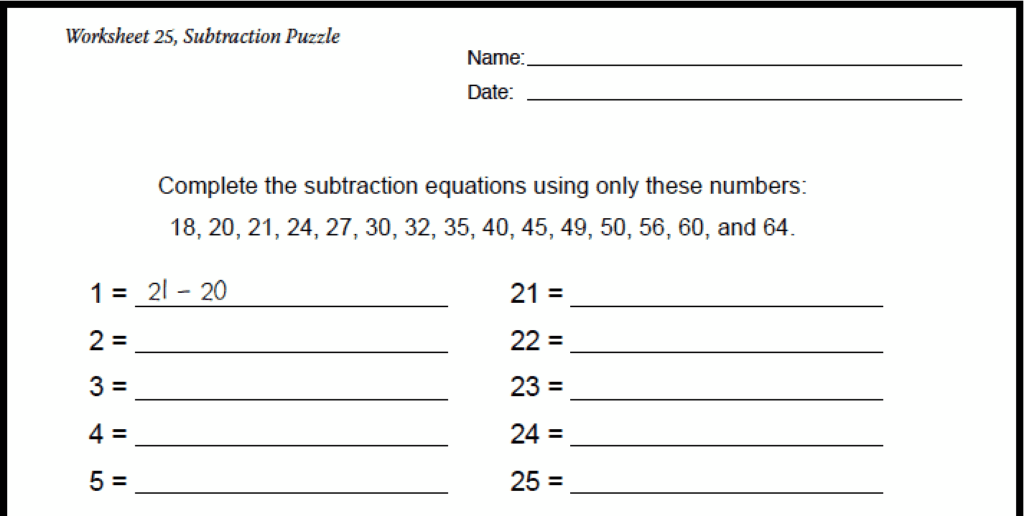
In 2nd grade Lessons 53 and 54, students are asked to complete Worksheet 25 using specific numbers. This worksheet is designed to be solved more like a puzzle than a worksheet. Here are some helpful strategies to help your students complete this worksheet without unnecessary stress. The Groundwork During the previous ten lessons, your students learned how to subtract. They studied subtraction math facts and learned a variety of subtraction strategies. This worksheet provides a unique way to practice those skills. The Puzzle For some students, the puzzle part of this worksheet is challenging. The struggle students have while completing this worksheet is that they are limited in the numbers they can use to solve the problems. For Worksheet 25, students can only use the following numbers in their solutions: 18, 20, 21, 24, 27, 30, 32, 35, 40, 45, 49, 50, 56, 60, and 64 The Process It is essential to recognize that many problems can have several solutions. For example, for problem 5 = _______, students can solve the problems with 5 = 35 – 30 or 5 = 40 – 35. Using Consecutive Numbers: When looking at each problem, students can look at the numbers immediately next to each other, subtract them, and see where the solution might fit. For example, the student can use 20 and 18 to create this equation: 2 = 20 – 18. Students can also look at every other number or every third number to get the solutions they need. For example, the numbers 21 and 18 can be used to create the equation 3 = 21 – 18, and the numbers 27 and 18 can be used to create the equation 9 = 27 – 18. Using Addition: Students can also consider using addition to solve the problems. Looking at the equation, 7 = _______ and the list of numbers available, have your students solve addition problems until they find one that fits. 7 + 18 (number in the list) = 25. Is 25 on the list? No, so move to the following number. 7 + 20 (number in the list) = 27. Is 27 on the list? Yes. Your student can use that combination on their worksheet: 7 = 27 – 20. They can continue this strategy for other problems, as well. Starting Backward: Your student can also work backward using their subtraction skills. Here is the list of numbers again for reference: 18, 20, 21, 24, 27, 30, 32, 35, 40, 45, 49, 50, 56, 60, and 64 Have your student start with 64 and subtract: 64 – 60 = 4 (They can put that in the “4 =” equation) 64 – 56 = 8 (They can put that in the “8 =” equation) 64 – 50 = 14 (they can put that one in the “14 =” equation), etc. The Requirements On the first day, you will work through Lesson 53, and your students will complete the first 10 problems. Then, the following day, you will work through Lesson 54, and the students will solve the remaining problems. Therefore, students have more than one day to finish this worksheet. You can help your students learn to use the previously described strategies to solve the problems on Worksheet 25. You might even have them work in small groups and learn from each other. Worksheet 25 encourages your students to try new processes, apply common sense, and demonstrate an understanding of the relationship between addition and subtraction. The Conclusion Yes, some students find this worksheet frustrating or challenging. However, frustration is part of the learning process, and challenge develops perseverance. With your encouragement and the use of strategies, your students will grow in their critical thinking and problem-solving skills. Do not hesitate to contact us if you have any questions about the RightStart Math curriculum or worksheets.
RightStart Math March Newsletter
Happy Pi Day! RightStart Math hopes you have fun activities planned to celebrate Pi Day (March 14th). Here are some interesting facts about the number pi: Pi is a very old number used by Egyptians and Babylonians more than 4000 years ago. There is no end in sight. So far, it has been calculated out to 22 trillion digits. For centuries, mathematicians have been looking for a pattern within this unique decimal number, but so far, none have been found. The number 123456 is not found in the first million decimal digits In 1706, mathematician William Jones began calling this number pi. Until then, this was called, “the quantity which when the diameter is multiplied by it, yields the circumference.” And finally, in March of 2015, Rajveer Meena, a 21-year old student, recited pi to 70,000 decimal places. Let RightStart Math help you finish the year strong! If you have any questions about a RightStart Math lesson or about pacing, we want to help! So, do not hesitate to contact us. Tutoring Testimonies Be one of the first 10 people to submit a testimony stating how any of the tutoring programs have helped your students learn and get: $100 worth of FREE card decks for your classroom! Send your testimony to: info@rightstartclassroom.com Your RightStart Math partners, Teresa, Rachel, Maren, and Kathleen