Winter Holiday Bingo Cards

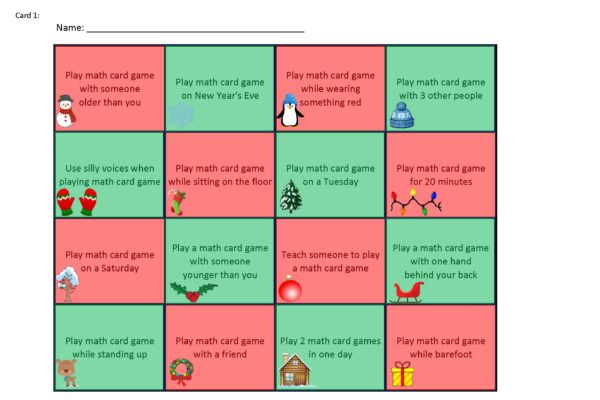
A Fun Way to Practice Math Facts during the Break! We know how important it is for students to keep up their math facts, even during long weekends and holiday breaks. So, we would like to provide a free resource you can use to encourage your students to practice math facts during the upcoming break. To that end, we have created fun, winter-themed Bingo cards. These cards will foster opportunities for your students to engage with their family and friends through fun – and maybe a little silly – activities. You can choose from two styles: full-colored cards or reduced-colored cards. Choose the style that best meets your printing needs. There are six different card arrangements for each style. Full-Colored Bingo Cards Reduced-Color Bingo Cards Ideas to Encourage Participation You can encourage student participation by having a contest to see how many of your students can complete a row, column, or even the entire Winter Bingo cards! Break the class into teams to see which team wins and reward them with a special prize or celebration upon their return to school after the break. Give your students a list of games to choose from to ensure they practice the facts they need. Or you can open it up to student preferences, letting them choose any game they want to play. If you would like a list of games that might be grade-level or skill-appropriate, feel free to contact us! We want to help you ensure that your students continue learning while they enjoy practicing math facts by playing card games. Also, remember that we have all the game instructions available through a subscription to Vimeo. Check this link out for more information about the video game instructions. From all of us at RightStart Math, We hope you have a restful and happy winter holiday break! Your RightStart Math partners, Teresa, Rachel, Maren, and Kathleen
Math Manipulatives, by Dr. Joan A. Cotter

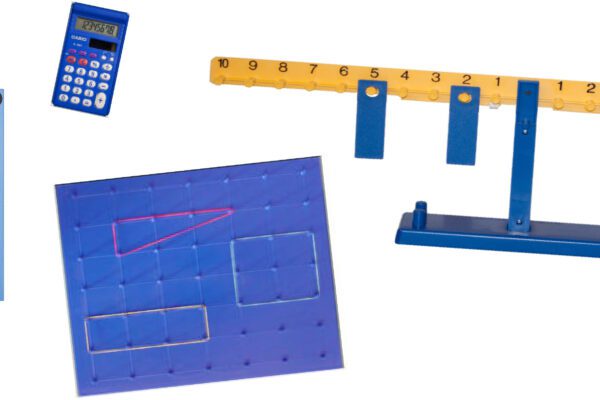
Should teachers use manipulatives when teaching math? What is the purpose of manipulatives? Are some manipulatives better than others? Every mathematics teacher should ask these questions as consider how to effectively teach their students. Let’s start by considering: What is a manipulative? A manipulative is a tangible object a child can physically handle to learn math. Some curricula do not encourage concrete manipulatives at all. Other curricula only use physical manipulatives as a last resort or when the child has learning difficulties. However, other programs, like RightStart Math, use concrete manipulatives as a tool for understanding. What makes an excellent manipulative? An excellent physical manipulative is one the child can imagine, internalize, visualize, and use in their mind. RightStart Math uses specific manipulatives to ensure students can visualize and internalize the math concepts they are being taught. A few of the excellent manipulatives used throughout the RightStart Math curriculum are the Cotter Abacus, overlapping place value cards, fraction charts, base-10 picture cards, and centimeter cubes. How long should my students use manipulatives? According to research, it takes a child one year of regularly using the manipulative to gain the full benefit of it. Many teachers use a manipulative to demonstrate a concept but do not allow enough time for students to explore, discover, and apply mathematical ideas. Remember, a good manipulative can be internalized. It takes time for a student to visualize the concepts a manipulative conveys. Aren’t all math materials considered manipulatives? Many believe that math materials such as rulers, geoboards, calculators, goniometers, clocks, and coins are manipulatives. But really, they are math tools and applications of math, not manipulatives. How important are manipulatives, anyway? Researchers have found there are two vital outcomes when children use manipulatives: They learn and understand mathematics better They have a positive attitude toward math These two outcomes occur when manipulatives are used while teaching a mathematical idea, not as a reward for completing a project or assignment. When concrete materials and games are considered rewards for good behavior, the student views the manipulative as nonessential and is less likely to take it seriously. However, simply using a manipulative does not guarantee the student understands a math concept. Ben A. Sueltz stated, Devices themselves will teach very little arithmetic. It is the guidance of a good teacher that determines their usefulness in discovery and learning. “Counting devices and their uses.” Arithmetic Teacher 1, no. 1 (1954): 25-30 Can I use everyday objects as manipulatives? Some professionals suggest that objects commonly found within the home are good alternatives to math manipulatives because they make math seem more relevant. While this might be true for some math concepts, everyday items do not necessarily make a good math manipulative. In fact, the more interesting the object is in its own right, the harder it is for the child to see the intended mathematical idea it is trying to demonstrate. For example, students who use raisins and candies to view and manipulate quantities can find the treats too tempting, and their attention is pulled away from the math concept. Summary Teachers and schools can choose from a wide array of manipulatives to use in their math classrooms. Each year, new manipulatives are being developed. However, teachers should be selective and intentional to only incorporate good manipulatives in their instruction. The manipulatives they choose should help students understand abstract concepts, make mathematical connections, and enjoy learning math.